
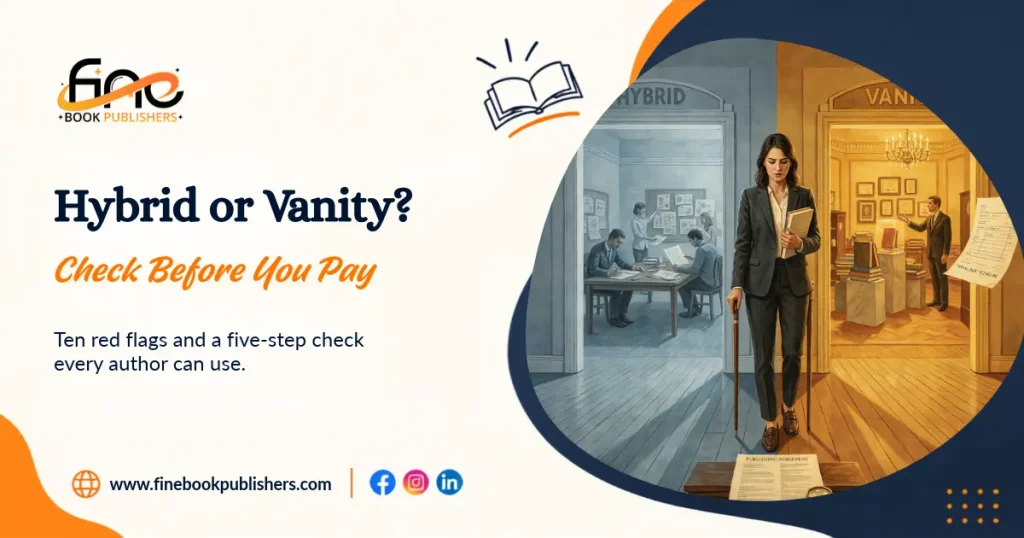
Introduction: The clearest vanity press warning signs are simple. The company accepts your manuscript almost instantly, charges large upfront fees, and earns its money from you instead of from readers. Many of these companies now call themselves “hybrid publishers” to sound more credible. This guide is for first-time and self-published authors who have an offer in their inbox, or who are comparing publishers, and want to check before paying anyone.
You don’t need legal training to protect yourself. You need a short list of questions, a few free lookups, and the willingness to pause when someone pushes you to hurry.
Quick Answer
Key takeaway: A vanity press publishes nearly anything for a fee, with little editorial vetting and a business model built on author payments. A legitimate hybrid publisher turns manuscripts down, publishes under its own imprint, and earns real money from book sales. To tell them apart, check whether the company rejects books, whether its fees and royalties are written in plain numbers, and whether you can verify its books and authors independently. Treat unsolicited offers, pressure to decide fast, and guaranteed results as reasons to stop and investigate.
Quick-Start Checklist: A Five-Minute Check Before You Reply
- Did they contact you first, out of the blue? Pause, and verify before you answer.
- Does the email come from the company’s own domain, or from a free webmail address?
- Can you find real books from this company in stores and library catalogs, with real reviews?
- Are the fees, services, and royalty percentage written down in specific numbers?
- Does anyone urge you to sign or pay quickly because a deal is “about to expire”?
If you answer “yes” to the first, second, or fifth question, slow down. If you answer “no” to the third or fourth, keep going before you send a cent.
What Is a Vanity Press, and How Is It Different From a Hybrid?
A vanity press makes its money from authors. It will usually accept any manuscript that comes with a payment, whatever its quality or sales potential. A hybrid publisher also asks authors to share costs, but it screens submissions, works under its own imprint, and depends on book sales for a real part of its income.
That difference matters because it decides who the company is working for. A publisher that profits from your sales wants your book to succeed. A company that profits mainly from your fees has little reason to care once the check clears.
The Independent Book Publishers Association (IBPA) publishes criteria for professional hybrid publishers. They include vetting submissions, being transparent in business practices, offering a clear and negotiable contract, and publishing under the company’s own ISBNs. IBPA says a company that meets only some of the criteria should not call itself hybrid. If you want the full comparison first, read our upcoming guide to hybrid publishing, then come back to this checklist.
Why So Many Vanity Presses Now Say “Hybrid”
The word “hybrid” has no legal definition, so anyone can use it. It also sounds modern and respectable, which makes it a useful label for companies that want to separate themselves from the old “vanity” reputation.
The label alone proves nothing. The only reliable test is how the company behaves: what it rejects, what it charges, what it puts in writing, and what its books actually do in the market.
10 Warning Signs to Watch For
| Warning sign | What it looks like | Question to ask |
| Instant acceptance | Your manuscript is “approved” within a day or two, with generic praise | “Who reviewed my book, and what did they say about it?” |
| Cold outreach | A stranger emails or calls about your self-published book | “How did you find me, and can I verify you independently?” |
| Vague fees | A bundled package with no itemized services | “Can you list each service and its price in writing?” |
| Fuzzy royalties | “Competitive royalties” with no percentage | “What percentage, and net of what costs?” |
| Pressure to buy your own books | A bulk purchase tied to signing | “Is this purchase required, yes or no?” |
| Guaranteed results | Promises of sales, bestseller status, or bookstore placement | “What exactly do you guarantee in the contract?” |
| Hard rights grab | Broad rights well beyond printing and distribution | “Which rights do you take, and for how long?” |
| Costly exits | Fees or long delays to get your rights back | “What is the process and cost to end the contract?” |
| Thin track record | Few real books, no verifiable authors, stock-photo staff | “Can I speak with three current authors?” |
| Free webmail and fake urgency | Gmail-style addresses, “offer expires today” language | “Can we continue by phone after I verify your company?” |
No single sign proves bad faith. A cluster of them should change your decision.
The pitch tells you a lot
Pay attention to who starts the conversation. Real publishers and agents rarely cold-contact authors to ask for money. Writer Beware, the scam-tracking project run by Victoria Strauss, has documented fake publishers and agents who open with flattery and quickly move to fees. A real house also doesn’t describe itself with labels like “traditional publisher” in a sales pitch, since it assumes you already know what it is.
The contract tells you the rest
Read every clause on rights, royalties, reversion, and termination. The Authors Guild, which offers contract review to members, says authors should never have to buy copies of their own book to win a contract. It also warns that some presses deduct printing and distribution costs from royalties even after authors paid upfront. For more detail, see the Authors Guild’s guide to hybrid publishing contracts.
Vanity Press vs Publishing Scam: Not the Same Thing
A vanity press usually delivers something, even if the quality is poor or the price is inflated. A publishing scam often delivers nothing. The company may not exist, the “agent” may be a fake identity, or the “marketing package” may produce no real work.
Scams also tend to arrive in disguise. Writer Beware and the Authors Guild have reported impersonators who copy the names of real publishers, agents, and media outlets. Writer Beware has also tracked a surge of personalized, AI-assisted marketing pitches that look convincing at first glance. If an offer references your book warmly but asks for payment up front, treat that as a signal, not a compliment.
Here is a quick way to separate the two. A vanity press asks for money to publish your book. A scam asks for money for something that may never happen, such as a film deal, a “book club feature,” or an exclusive promotion.
An Example of How It Can Play Out
Picture a debut author who self-published a memoir last spring. A message arrives from someone who says a “publishing house” loves the book and wants to reprint it. The sender uses a free email address, praises one chapter by name, and says the offer closes in 48 hours. The “package” costs several thousand dollars, with no itemized services.
None of those details prove a scam on their own. Together, they make a pattern: unsolicited contact, flattery, a deadline, and a bundled price. The author’s best move is to stop, verify the company, and ask for everything in writing. This is an illustrative scenario, not a real client case.
How to Verify Any Publisher in 5 Steps
- Look up the company name with the word “scam” or “complaints.” Then check Writer Beware and the Authors Guild’s published scam alerts for matches.
- Check the email domain and website. A real company emails from its own domain. Run staff photos through a reverse image search, since some fake sites use generated or stolen faces.
- Find the books. Search for titles the company says it published. Look for real listings, real reviews, and ISBNs registered to the company’s imprint.
- Request the contract and fee schedule before any payment. A legitimate company shares sample terms and answers questions in writing.
- Talk to current authors. Ask about payment timing, communication, and what the company actually delivered.
Finally, compare what you find with the services you’d need anyway. Our breakdown of what book publishing services include can help you judge whether a fee matches the work.
What to Do If You Already Paid or Signed
First, stop sending money. Then gather your contract, invoices, emails, and any marketing promises in one folder.
Next, read your reversion and termination clauses. If the company has not delivered what it promised, send a written request, keep copies, and consider getting contract review from a publishing attorney or an author organization. If you suspect fraud, report it to the Authors Guild and Writer Beware. You can also report fraud to the FTC at reportfraud.ftc.gov. If you paid by card or bank transfer, contact your bank quickly to ask about options.
This is general information, not legal advice. Your options depend on your contract and location.
Common Mistakes Authors Make
- Trusting a polished website or a warm email as proof of legitimacy
- Paying before reading the full contract
- Assuming an offer that praises your book must come from someone who read it
- Skipping the step of talking to current authors
- Ignoring how the company handles rights and exit terms
- Feeling embarrassed and staying silent, which helps the next victim
Frequently Asked Questions
What are the main vanity press warning signs?
Instant acceptance, large upfront fees, vague services, unclear royalties, pressure to buy your own books, and guarantees of sales or placement. Several signs together matter more than any single one.
How can I tell if a hybrid publisher is really a vanity press?
Check whether it rejects manuscripts, publishes under its own imprint, shows clear fees and royalties, and has verifiable books and authors. Compare the company with IBPA’s published criteria.
Is a vanity press the same as a scam?
No. A vanity press usually delivers a product, though often at inflated prices and with weak support. A scam may deliver nothing, or may not exist at all.
Is it a red flag when a publisher contacts me first?
Often, yes. Established publishers and agents rarely cold-contact authors and ask for money. Verify the sender through independent channels before you respond.
Do real hybrid publishers charge authors?
Yes, many do. That alone doesn’t make a company a vanity press. The difference lies in selectivity, transparency, imprint, distribution, and how the company earns its money.
Can I get my rights back from a vanity press?
It depends on your contract. Look for reversion and termination clauses, keep your communications, and consider contract review from a publishing attorney or an author organization.
Where can I report a publishing scam?
Report it to Writer Beware and the Authors Guild. If money was involved, you can also file a report with the FTC and contact your bank.
Final Thoughts
You can protect yourself without becoming an expert. Slow down, verify independently, and treat vague money language as a reason to ask more questions. A company that respects authors will welcome the scrutiny.
If you’re weighing an offer and want a second set of eyes on the services, fees, and next steps, Fine Book Publishers can help you think through the questions to ask before you sign. The company states that authors keep ownership, publishing rights, royalties, and creative control.